UAT-9921 Deploys VoidLink Malware to Target Technology and Financial Sectors
VoidLink Malware Enterprise Espionage Linux Targeting Cloud Infrastructure
Overview
VoidLink is a modular, cloud-focused malware framework used by the newly identified threat actor UAT-9921 to compromise primarily Linux-based servers in technology and financial sectors, with opportunistic targeting in Europe and beyond.
Explicitly described as "defense-contractor-grade" by Cisco Talos in terms of structure and capabilities, VoidLink is designed for long-term espionage and deep network access rather than smash-and-grab attacks.
The framework uses a sophisticated multi-component architecture with implants written in Zig, plugins in C, and backend services in Go, supporting modular plugin deployment, mesh peer-to-peer C2, rootkit-level evasion, and cross-platform capability including Windows variants.
Technical Specifications
| Attribute | Details |
|---|---|
| Malware Family | VoidLink (Modular Framework) |
| Threat Actor | UAT-9921 (Chinese-linked, established ~2019+) |
| Primary Target Sectors | Technology, Financial Services |
| Primary Platform | Linux (servers, cloud infrastructure) |
| Secondary Platforms | Windows (DLL side-loading variant) |
| Development Languages | Zig (implants), C (plugins), Go (backend services) |
| Architecture | Modular plugin system with mesh C2 |
| Initial Access Vectors | Stolen credentials, Java deserialization exploits |
| Key Capabilities | Rootkit deployment, EDR bypass, lateral movement, data theft |
| Evasion Methods | eBPF/LKM rootkits, cloud-environment awareness, anti-analysis |
Affected Products
- Linux servers in technology and financial sectors across Europe and globally
- Apache Dubbo and similar Java-based middleware and RPC services
- Systems vulnerable to Java deserialization/serialization attacks
- Cloud environments (containers, orchestrators, Kubernetes)
- Enterprise and SaaS providers hosting customer workloads
- Windows systems with exposed DLL side-loading attack vectors
- Status: Actively targeted in ongoing campaigns
Technical Details
VoidLink Framework Architecture
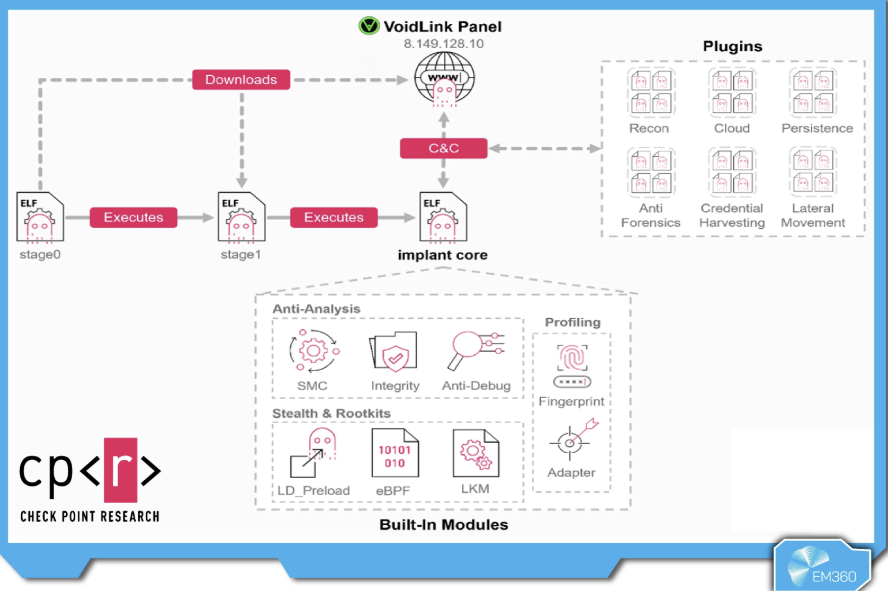
Multi-Component Design
- Implants: Written in Zig for efficiency and portability
- Plugins: Developed in C for custom capability loading
- Backend Services: Built in Go for cross-platform control infrastructure
- Modular System: Operators compile and deploy custom plugins on demand
Plugin Capabilities
- Reconnaissance and system enumeration
- Lateral movement and network scanning
- Exploitation and privilege escalation
- Anti-forensics and log manipulation
- Data theft and exfiltration
- Persistence and rootkit installation
- EDR/XDR evasion and detection bypass
Advanced Evasion & Persistence
Kernel-Level Operations
- eBPF (Extended Berkeley Packet Filter) rootkits for stealth
- LKM (Linux Kernel Module) rootkits for system compromise
- Kernel-level visibility and behavioral hiding
- Anti-analysis features to frustrate malware research
Cloud-Environment Awareness
- Container detection and adaptation
- Kubernetes and orchestrator compatibility
- Cloud service reconnaissance and exploitation
- Virtual machine and hypervisor detection
EDR Bypass & Evasion
- Advanced evasion of endpoint detection and response systems
- Anti-analysis and debugging defeat mechanisms
- Behavior obfuscation and signature evasion
- Detection-resistant execution patterns
Mesh Command & Control (C2)
Peer-to-Peer Architecture
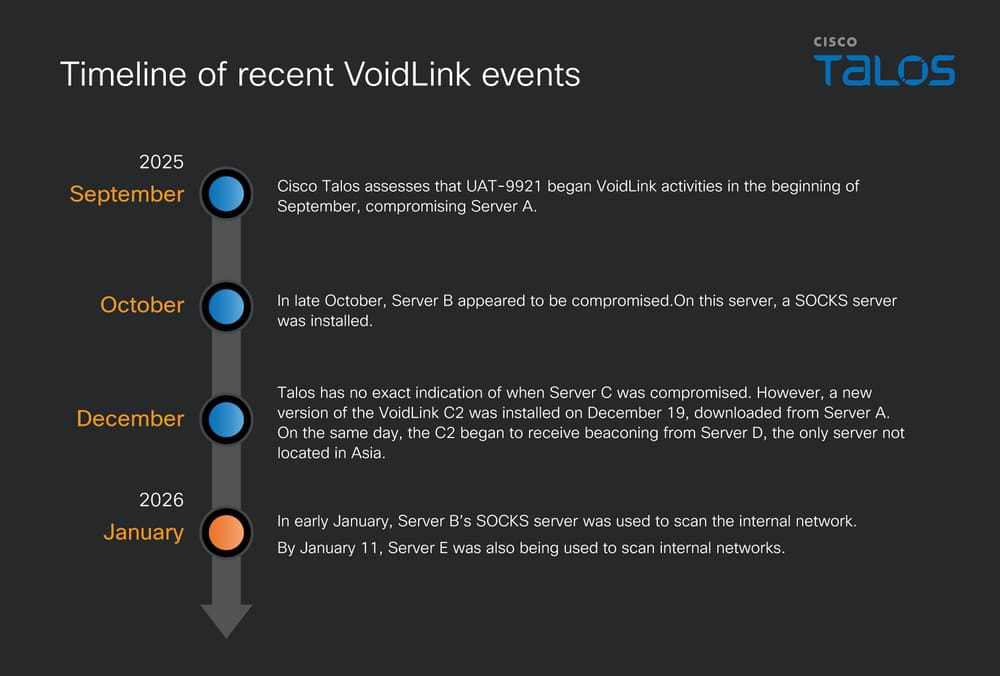
- Compromised hosts act as SOCKS proxies for other nodes
- Decentralized relay network between infected systems
- Traffic routing through multiple compromised nodes
- Enhanced evasion of network segmentation and egress controls
Advanced Command Infrastructure
- Dynamic plugin compilation and deployment
- Operator-driven customization of malware behavior
- Exfiltration through mesh nodes to avoid direct egress detection
- Multiple communication channels and redundancy
Cross-Platform Capability
- Primary: Linux implants for servers and cloud infrastructure
- Secondary: Windows variant delivered via DLL side-loading
- Flexibility: Framework designed for multi-OS compromise support
- Consistency: Core capabilities and command structure unified across platforms
Intelligence Assessment
- Chinese-language proficiency indicators suggest origin
- Development and operations split between distinct teams
- Potential AI-assisted development patterns ("compile-on-demand" indicators)
- Evolution from traditional tooling (since ~2019) to VoidLink framework (recent years)
- Despite AI-assisted patterns, overall campaign execution is operator-driven
Attack Scenario
-
Reconnaissance & Targeting:
- UAT-9921 scans for exposed internet-facing services in technology and financial sectors
- Identifies Java deserialization vulnerabilities in Apache Dubbo and similar middleware
- Profiles organizations for high-value targets and opportunistic victims
-
Initial Access:
- Uses stolen credentials (from prior breaches, phishing, credential stuffing)
- Exploits Java deserialization flaws (e.g., Apache Dubbo RCE, similar vulnerabilities)
- Gains initial shell access to internet-facing service or application server
-
Implant Deployment:
- Downloads and executes VoidLink implant on compromised Linux server
- Establishes persistent C2 communication with UAT-9921 infrastructure
- Configures compromised host as SOCKS proxy for internal network access
-
Internal Reconnaissance:
- Deploys reconnaissance plugins to enumerate internal network
- Scans for additional systems using tools like Fscan
- Maps network topology, asset inventory, and security controls
- Performs lateral-movement planning and target prioritization
-
Credential & Privilege Escalation:
- Dynamically loads credential-theft plugins
- Harvests local and domain credentials from compromised system
- Exploits privilege escalation vulnerabilities
- Compromises service accounts and administrative credentials
-
Lateral Movement & Expansion:
- Uses stolen credentials and mesh C2 to move laterally
- Deploys VoidLink implants to additional systems
- Builds interconnected compromised-host network
- Expands access across cloud infrastructure and on-premises systems
-
Persistence & Long-Term Access:
- Deploys kernel-level rootkits (eBPF/LKM) for deep persistence
- Implements anti-forensics capabilities to hide malware presence
- Maintains resilient backdoors across multiple systems
- Establishes long-term operational access for espionage
-
Data Collection & Exfiltration:
- Dynamically loads data-theft plugins for targeted exfiltration
- Collects intellectual property and sensitive business data
- Harvests customer information and internal communications
- Routes exfiltration through mesh nodes to evade detection
Impact Assessment
- Unauthorized access to sensitive intellectual property and trade secrets
- Exfiltration of financial data, customer information, and internal communications
- Access to proprietary source code and development systems
- Theft of strategic business plans and competitive intelligence
- Long-term undetected access enabling comprehensive data harvesting
- Complete compromise of critical Linux server infrastructure
- Kernel-level control through rootkit deployment
- Persistent backdoor access enabling ongoing attacker operations
- Compromised systems used as pivot points for further exploitation
- Degraded trust in system integrity and administrative controls
- Mesh C2 network enables wide internal propagation
- Circumvention of network segmentation and access controls
- Lateral movement to hundreds or thousands of systems
- Potential compromise of entire cloud infrastructure and workloads
- Service-account compromise enabling administrative-level access
- Severe data breach liabilities and regulatory consequences
- Loss or disruption of critical cloud services and operations
- Reputational damage especially for financial and SaaS providers
- Customer data compromise affecting trust and compliance standing
- Prolonged incident response due to advanced evasion capabilities
- Months-long undetected compromise before discovery
Mitigation Strategies
Internet-Facing Service Hardening
- Critical Patches: Immediately patch Apache Dubbo and all Java middleware frameworks for deserialization vulnerabilities
- RPC Security: Disable unnecessary remote procedure call services and serialization mechanisms
- Vendor Mitigations: Apply all vendor-recommended deserialization protections and input validation
- Service Inventory: Maintain complete inventory of all internet-exposed services and versions
- Regular Scanning: Continuously scan for unpatched or misconfigurations of external services
Credential & Access Security
- Unique Credentials: Use unique, long, randomly-generated credentials for all external-facing services
- Credential Rotation: Implement regular credential rotation for service accounts and administrative access
- MFA Enforcement: Enable multi-factor authentication on all external-facing applications and portals
- Credential Monitoring: Monitor for unauthorized credential usage and suspicious authentication patterns
- Privileged Access Management (PAM): Vault and manage administrative credentials through PAM systems
- Avoid Credential Reuse: Never reuse credentials across systems or applications
Network Detection & Monitoring
- SOCKS Proxy Detection: Monitor for unauthorized SOCKS proxy activity and suspicious process patterns
- Outbound Connection Monitoring: Alert on unusual outbound connections from Linux servers to unknown hosts
- Lateral Scan Detection: Detect and alert on internal network scanning (Fscan patterns, port scans, service enumeration)
- C2 Traffic Analysis: Monitor for mesh C2 communication patterns and command relay traffic
- DNS Monitoring: Watch for suspicious DNS queries and domain resolution patterns
- Egress Filtering: Implement strict egress firewall rules to limit outbound connections
Endpoint & Kernel Detection
- EDR/XDR with Linux Support: Deploy endpoint detection and response with Linux-specific visibility
- eBPF Monitoring: Monitor for suspicious eBPF program loading and execution
- Kernel Module Monitoring: Alert on unauthorized kernel module (LKM) loading or execution
- Process Behavior Analysis: Detect rootkit-level process hiding and behavioral anomalies
- Anomalous Kernel Activity: Monitor system calls for unusual patterns indicating kernel compromise
- Anti-Rootkit Scanning: Deploy tools specifically designed to detect and identify rootkit presence
Network Architecture & Segmentation
- Zero Trust Architecture: Implement zero trust principles with assumed breach mindset
- Network Segmentation: Segment cloud and on-premises networks to prevent lateral movement
- Service Isolation: Isolate critical services and databases from general network access
- Least Privilege Access: Minimize inter-service communication and enforce principle of least privilege
- Service Account Restrictions: Limit privileges of service accounts to only required functionality
- Egress Control: Implement granular egress controls limiting where systems can communicate
Resources and References
Incident Reports
Last Updated: February 16, 2026