Apple Mercenary Spyware Threat Notifications – 2026
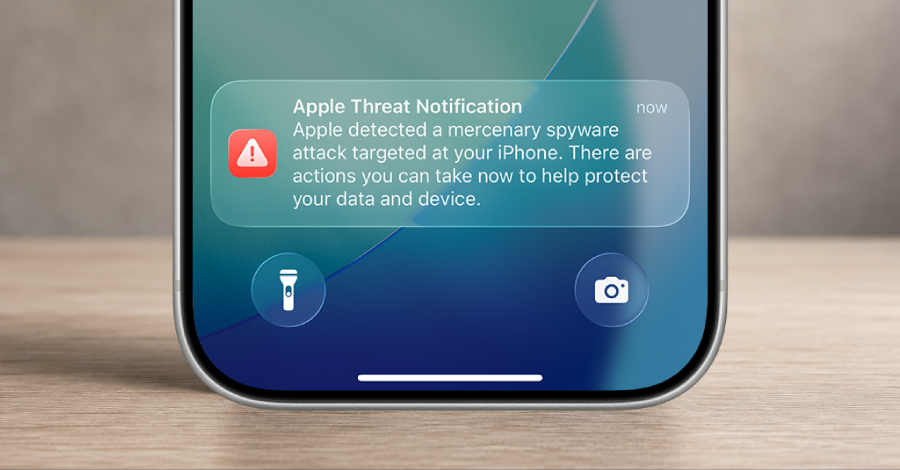
Apple Threat Notifications Mercenary Spyware High-Value Targeting Potential Zero-Click Exploits Mobile Surveillance Risk
Overview
Apple issued a new wave of threat notifications warning users in 110 countries that they may have been individually targeted by mercenary spyware.
These operations differ from conventional malware campaigns because attackers invest substantial resources to compromise a small number of high-value targets. Apple has operated its threat-notification program since 2021 and has issued notifications across more than 150 countries.
Technical Details
Apple has not publicly disclosed the specific exploit chain, CVEs, spyware family, attacker infrastructure, or threat actor responsible for this notification wave.
Mercenary spyware operations can exploit vulnerabilities in mobile operating systems and applications and may use highly sophisticated techniques, including potentially zero-click exploitation paths.
Apple relies on internal threat intelligence and investigations to identify activity consistent with mercenary spyware attacks.
Technical Specifications
| Attribute | Details |
|---|---|
| Alert Type | Apple mercenary spyware threat notifications |
| Global Scope (Reported) | Users notified in 110 countries in this wave |
| Program History | Apple threat-notification program active since 2021 across 150+ countries |
| Exploit Chain Disclosure | Not publicly disclosed for this wave |
| Known CVE Disclosure | None publicly provided in cited reporting |
| Potential Tactics | Sophisticated mobile exploitation, including possible zero-click paths |
| Targeting Model | Individually targeted, high-value victim selection |
| Detection Basis | Apple internal threat intelligence and investigative analysis |
Affected Products
- Apple ecosystem endpoints potentially targeted in mercenary spyware operations
- iPhone and iPad devices running iOS and iPadOS
- Mac systems running macOS
- Apple Accounts and associated communications/data ecosystems for targeted individuals
Attack Scenario
- Target identification and profiling of a high-value individual.
- Attacker develops or acquires a suitable exploit chain.
- Vulnerability exploitation occurs against iPhone, iPad, or Mac components.
- Code execution and privilege escalation are achieved on the target device.
- Spyware payload is deployed for persistence and surveillance.
- Messages, files, communications, location, and other sensitive data are collected.
- Stolen data is exfiltrated to attacker-controlled infrastructure.
The exact exploit chain used in this campaign has not been publicly confirmed.
Impact Assessment
- Advanced spyware access can alter device state and security configurations without user awareness
- Privileged compromise may enable stealthy tampering with device artifacts and logs
- Targeted compromise can undermine trust in secure communications workflows
- Sensitive messages, contacts, files, location, and account-linked data may be exposed
- High-value users may face strategic surveillance and intelligence collection risks
- Organizational information can be indirectly exposed through compromise of individual target devices
- Availability disruption is not the primary objective in reported mercenary spyware operations
- Incident response actions may require temporary device isolation, resets, and credential rotation
- Notification-driven containment can still affect user productivity and operational continuity
Mitigation Strategies
Immediate Hardening
- Enable Apple Lockdown Mode on potentially targeted devices.
- Update iOS, iPadOS, macOS, and all Apple devices to the latest security releases.
- Enable strong MFA/2FA protections for Apple Accounts.
User and Communication Safety
- Avoid suspicious links, attachments, and unexpected messages.
- Verify threat notifications only through official Apple account and support channels.
- Preserve relevant evidence if compromise is suspected.
Incident Response and Forensics
- Seek assistance from qualified mobile-forensics and cybersecurity teams.
- Prioritize review of devices used by high-risk personnel and executives.
- Conduct compromise assessments before returning suspected devices to sensitive workflows.
Resources and References
Public Reporting
Last Updated: August 18, 2026