Cisco Unified Contact Center Express (Unified CCX) Vulnerabilities
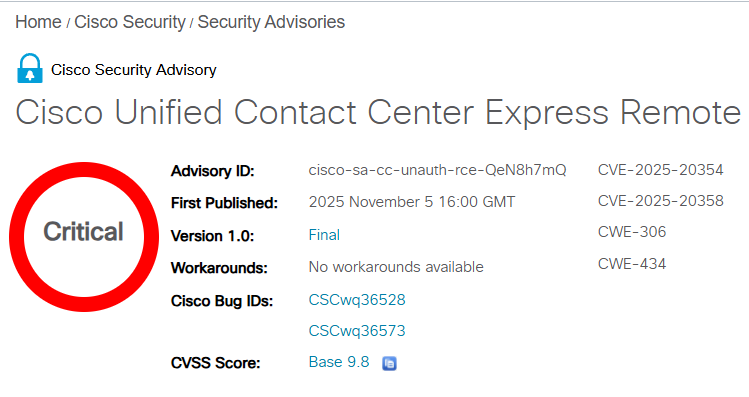
CVE-2025-20354 CVE-2025-20358 Remote Code Execution Authentication Bypass
Overview
Cisco disclosed two critical vulnerabilities in its Unified Contact Center Express (Unified CCX) appliance that could allow remote attackers to execute arbitrary commands or gain administrative control without authentication. The flaws reside in the Java RMI process and the CCX Editor authentication flow. Cisco released fixed versions 12.5 SU3 ES07 and 15.0 ES01. No exploitation has been observed in the wild at publication time.
Technical Specifications
| Attribute | Details |
|---|---|
| CVE IDs | CVE-2025-20354, CVE-2025-20358 |
| Vulnerability Type | Remote Code Execution (RCE), Authentication Bypass |
| Attack Vector | Network (remote) |
| Authentication | None required (for CVE-20354); Weak authentication (for CVE-20358) |
| Complexity | Low |
| Privileges Required | None |
| User Interaction | Not required |
| CVSS Scores | 9.8 (CVE-2025-20354), 9.4 (CVE-2025-20358) |
| Affected Versions | Unified CCX 12.5 SU3 and earlier (before ES07); 15.0 before ES01 |
| Fixed Versions | Unified CCX 12.5 SU3 ES07, 15.0 ES01 |
Attack Scenario
- Attacker identifies a vulnerable Unified CCX system exposed to the network.
- For CVE-2025-20354, the attacker connects to the Java RMI service and uploads a malicious file to the server, achieving root command execution.
- For CVE-2025-20358, the attacker sets up a malicious server that impersonates the legitimate CCX server; the CCX Editor authenticates incorrectly and grants administrator privileges.
- The attacker can then run arbitrary scripts or deploy malware within the contact-center environment, gaining persistence and potential lateral movement.
Impact Assessment
- Full compromise of Unified CCX configuration and operating system
- Arbitrary file upload and script execution with root privileges
- Tampering with contact-center call handling logic
- Access to sensitive contact-center data
- Disclosure of internal scripts and configurations
- Exposure of connected systems credentials (CUIC, CCE, CUCM)
- Service disruption due to command injection or file corruption
- Possible denial of service from malicious script execution
- Potential lateral movement to other Cisco Unified systems
- Launchpad for wider network compromise
- Root-level persistence across the appliance
Mitigation Strategies
Patching
-
Upgrade immediately to fixed versions:
-
Unified CCX 12.5 SU3 ES07
- Unified CCX 15.0 ES01
- There are no workarounds for these vulnerabilities.
Network Hardening
- Restrict access to Unified CCX management interfaces and Java RMI ports.
- Place CCX appliances behind firewalls with strict access controls.
- Segment contact-center servers from less-trusted networks.
Monitoring & Detection
- Enable detailed logging and alerting for RMI and Editor traffic.
- Monitor for unauthorized file uploads and script executions.
- Review network logs for traffic to unknown servers during Editor operations.
Access Controls
- Enforce administrative access over VPN or secure bastion hosts only.
- Regularly review and rotate credentials for CCX and connected systems.
- Disable or limit Editor access where not operationally required.
Technical Recommendations
Immediate Actions
- Identify all Unified CCX instances and their version/build.
- Apply the relevant patch immediately if below ES07 (12.5) or ES01 (15.0).
- Restrict external network access to the affected services.
- Enable and review security logging.
Short-term Measures
- Perform vulnerability scanning for open RMI endpoints.
- Audit connected systems (CUCM, CCE, CUIC) for shared credentials.
- Review contact-center configuration for unauthorized scripts.
Long-term Strategy
- Integrate Unified CCX into central patch management workflows.
- Implement continuous vulnerability assessment for Cisco appliances.
- Conduct periodic penetration testing on voice and contact-center infrastructure.
Resources and References
Official Documentation
- Cisco Security Advisory – cisco-sa-cc-unauth-rce-QeN8h7mQ
- Cisco Patches Critical Vulnerabilities in Contact Center Appliance – SecurityWeek
- Cisco Warns of New Firewall Exploit Variants – The Hacker News
- Cisco Firewalls Under Attack Surge – TechRadar
Risk Level: Critical
Both vulnerabilities allow remote code execution and privilege escalation without authentication. Systems must be patched immediately to prevent compromise.