RustDuck Botnet
IoT Botnet Rust Malware DDoS Multi-Architecture Linux/Embedded Threat
Overview
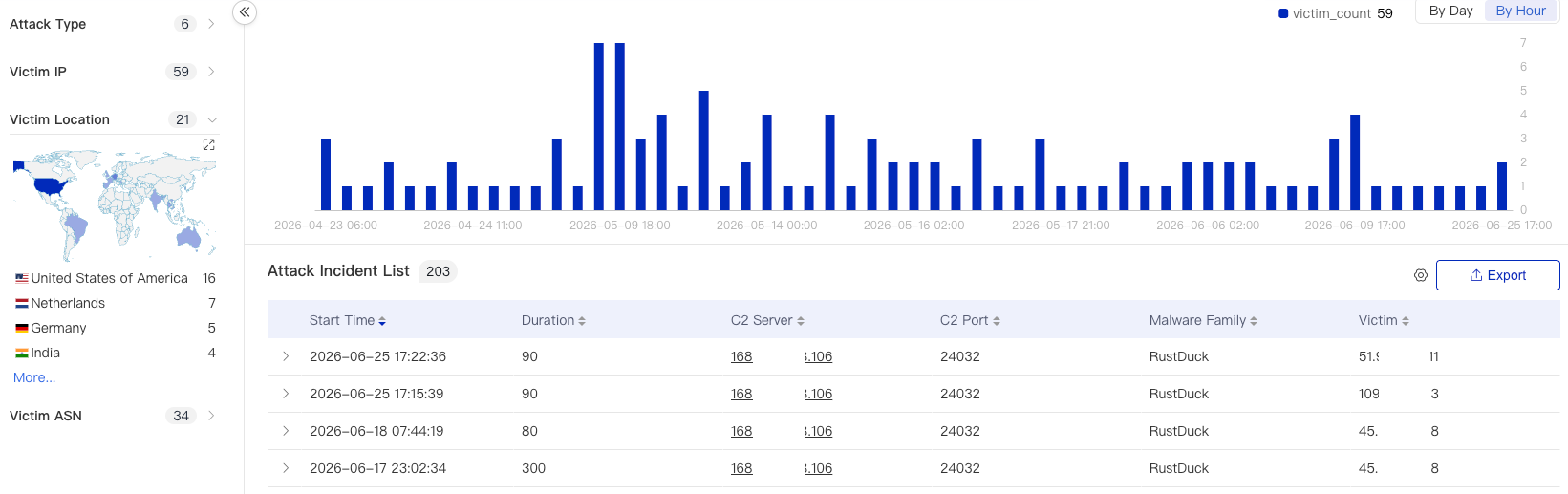
RustDuck is a rapidly evolving botnet malware family rewritten in Rust to improve stealth, portability, and performance. It targets vulnerable IoT devices, routers, Android TV boxes, IP cameras, and Linux servers to build a distributed botnet primarily used for large-scale DDoS operations. Researchers observed continuous development with stronger obfuscation and increasingly modular capabilities.
Technical Specifications
| Attribute | Details |
|---|---|
| Threat Name | RustDuck |
| Malware Type | Botnet malware |
| Primary Objective | Distributed Denial-of-Service (DDoS) attacks |
| Target Platforms | IoT devices, routers, Android TV boxes, IP cameras, Linux servers |
| Infection Method | Weak/default credentials and exploitation of known vulnerabilities |
| Architecture Support | ARM, MIPS, x86, x64 |
| Infection Chain | Multi-stage (loader + Rust payload) |
| Core Capabilities | TCP/UDP flooding, remote command execution, persistence, self-updating |
| C2 Model | Remote command-and-control infrastructure |
| CVE IDs | Not specified (campaign-level exploitation of multiple known flaws) |
Affected Products
- Internet-exposed IoT devices with weak or default credentials
- Unpatched consumer and enterprise routers
- Android TV boxes and IP cameras with insecure remote management
- Linux servers exposed to brute-force or known vulnerability exploitation
Attack Scenario
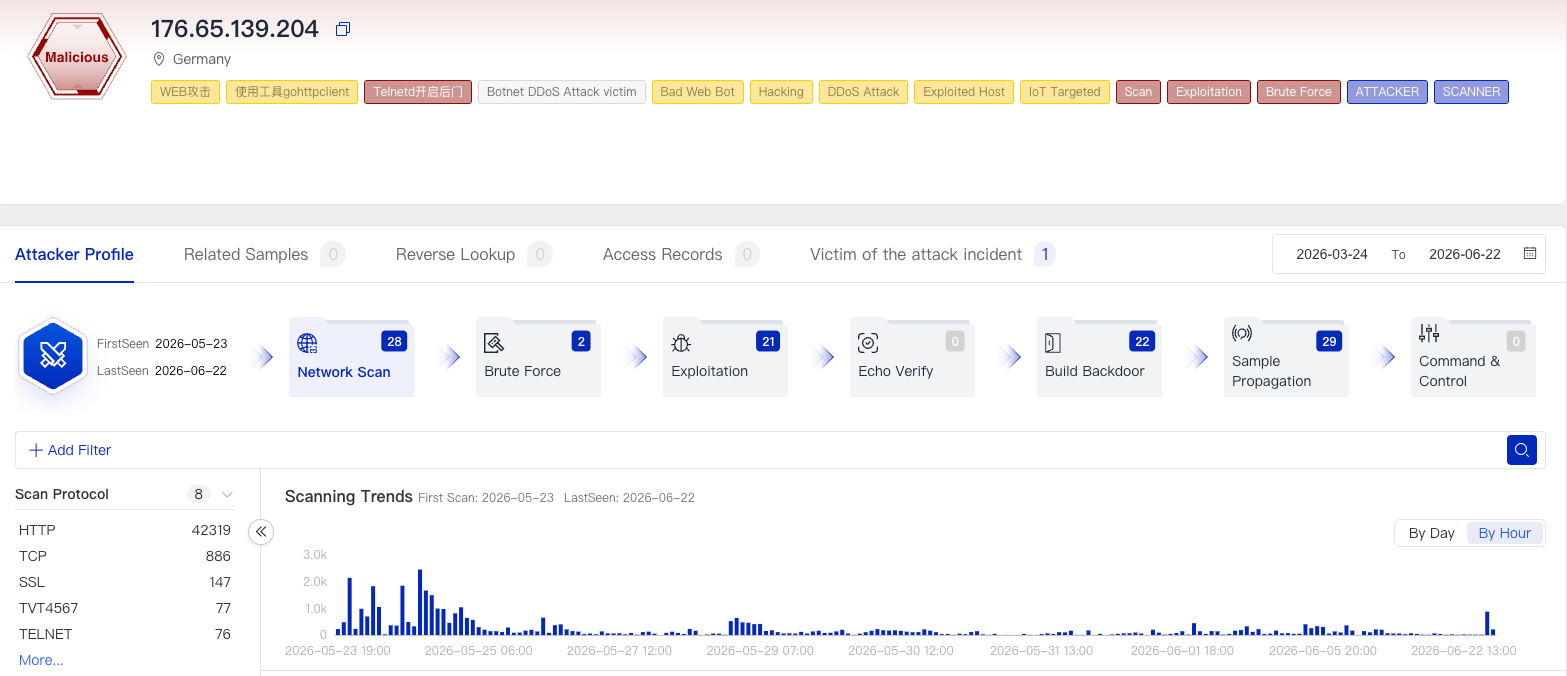
- Attackers scan the internet for vulnerable IoT, router, and Linux targets.
- Weak credentials or known vulnerabilities are used for initial access.
- A lightweight loader script or binary executes on the compromised system.
- The loader retrieves the main RustDuck payload from attacker-controlled infrastructure.
- The infected host connects to C2 infrastructure and is enrolled into the botnet.
- Operators issue commands to launch coordinated TCP/UDP flood attacks at selected targets.
Impact
- Compromise of routers, embedded systems, and Linux servers through unauthorized malware deployment
- Potential remote command execution and follow-on payload delivery via botnet control channels
- Elevated risk of lateral movement where IoT and production networks are poorly segmented
- Infected systems may expose network telemetry and environment details to attacker-controlled C2 servers
- Compromised edge devices can be leveraged as reconnaissance footholds against internal infrastructure
- Long-lived infections increase risk of credential interception and reuse in mixed-trust environments
- Coordinated DDoS attacks can trigger large-scale service outages
- Bandwidth exhaustion and network congestion degrade business-critical connectivity
- Operational disruption for organizations whose infrastructure is used as attack infrastructure
Mitigations
Immediate Actions
- Change default credentials on all IoT and edge devices
- Disable unnecessary remote administration services and internet-facing management ports
- Apply latest firmware and security patches across routers, cameras, and embedded systems
Short-term Measures
- Restrict internet exposure of management interfaces using ACLs, VPNs, or jump hosts
- Segment IoT and OT-style devices away from critical enterprise systems
- Block known malicious IPs and C2 domains from threat intelligence feeds
Monitoring & Detection
- Monitor outbound traffic for suspicious beaconing or unusual protocol/port behavior
- Deploy IDS/IPS signatures for botnet loader and C2 communication patterns
- Detect anomalous TCP/UDP flood generation from internal edge devices
Long-term Solutions
- Establish continuous asset inventory and vulnerability management for IoT fleets
- Enforce zero-trust style network isolation for unmanaged embedded endpoints
- Deploy DDoS protection and upstream traffic scrubbing for internet-facing services
Resources
Open-Source Reporting
Last Updated: July 1, 2026