Linux SCTP Flaw Could Let Local Users Gain Root

Kernel Privilege Escalation SCTP ASCONF Use-After-Free Container Escape Risk Local Exploitation
Overview
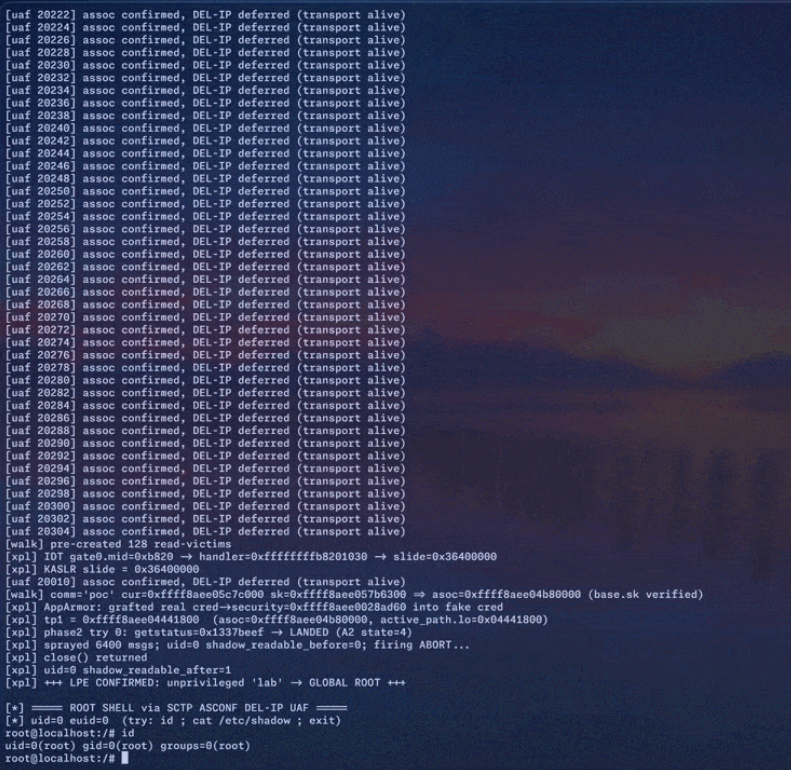
SCTPhantom is an approximately 18-year-old use-after-free vulnerability in the Linux kernel SCTP implementation, specifically in Dynamic Address Reconfiguration (ASCONF) handling. A local attacker who can reach SCTP functionality may exploit this memory-management flaw to escalate privileges to root.
Tencent researchers also demonstrated a container-escape scenario, showing that code running inside a container could pivot to host compromise when vulnerable conditions are present.
Technical Specifications
| Attribute | Details |
|---|---|
| Vulnerability Name | SCTPhantom |
| Affected Component | Linux kernel SCTP implementation (ASCONF/Dynamic Address Reconfiguration) |
| Vulnerability Type | Use-After-Free (UAF) |
| Flaw Age | Approximately 18 years |
| Root Cause | Inconsistent SCTP address deletion validation and transport-object selection logic |
| Trigger Condition | Crafted sequence of address add/delete operations plus wildcard delete |
| Security Effect | Frees SCTP transport object while stale pointer remains reachable |
| Exploit Outcome | Kernel memory corruption and local root privilege escalation |
| Container Impact | Tencent reported host-root results in 6 of 8 tested container-escape attempts |
Affected Products
- Linux systems with vulnerable SCTP kernel code paths
- Hosts where SCTP functionality is enabled and reachable by untrusted local code
- Containerized environments where workloads can interact with SCTP paths
- Cloud/Kubernetes nodes that share vulnerable host kernels
Attack Scenario
- An attacker gains local code execution via compromised account, application flaw, or container access.
- The attacker reaches SCTP functionality on the target kernel.
- Crafted SCTP/ASCONF operations trigger vulnerable address-reconfiguration behavior.
- A stale pointer references a previously freed SCTP transport object.
- Memory corruption occurs in kernel context, enabling privilege escalation.
- In containerized setups, successful exploitation may escalate from container context to host root.
Impact Assessment
- Local attackers can gain root-level control over affected hosts
- Kernel memory corruption can undermine trust boundaries and workload isolation
- Host compromise in shared environments may impact multiple tenants or services
- Root-level access may expose sensitive data, secrets, and service credentials
- Container-to-host escape can expose neighboring workload data on the same node
- Post-exploitation access can enable broader network reconnaissance and theft
- Kernel corruption can destabilize systems and trigger crashes
- Host compromise can interrupt services and container workloads
- Incident response and emergency patching may cause operational downtime
Mitigation Strategies
Immediate Actions
- Patch immediately to fixed kernel versions in the relevant branch: 6.6.148, 6.12.101, 6.18.42, or 7.1.6
- Apply distribution/vendor security updates (for example Debian, RHEL, Ubuntu) rather than relying only on upstream numbering
- Prioritize internet-adjacent, multi-tenant, and container-host systems for emergency updates
Short-term Measures
- Identify hosts and containers where SCTP is enabled or reachable
- Disable or remove the SCTP kernel module where operationally safe and not required
- Restrict local untrusted code execution paths on vulnerable systems
Monitoring & Detection
- Monitor abnormal SCTP activity and suspicious ASCONF patterns
- Alert on unexpected local privilege-escalation behavior and container breakout indicators
- Correlate kernel logs with process anomalies tied to SCTP interaction attempts
Long-term Solutions
- Review container hardening (seccomp, capabilities, user namespaces, network policy)
- Enforce least privilege across local users, services, and container workloads
- Integrate kernel exposure review into recurring vulnerability-management workflows
Resources and References
Last Updated: August 9, 2026