AsyncAPI npm Supply Chain Attack
Supply Chain Compromise npm Packages CI/CD Abuse GitHub Actions Miasma RAT
Overview
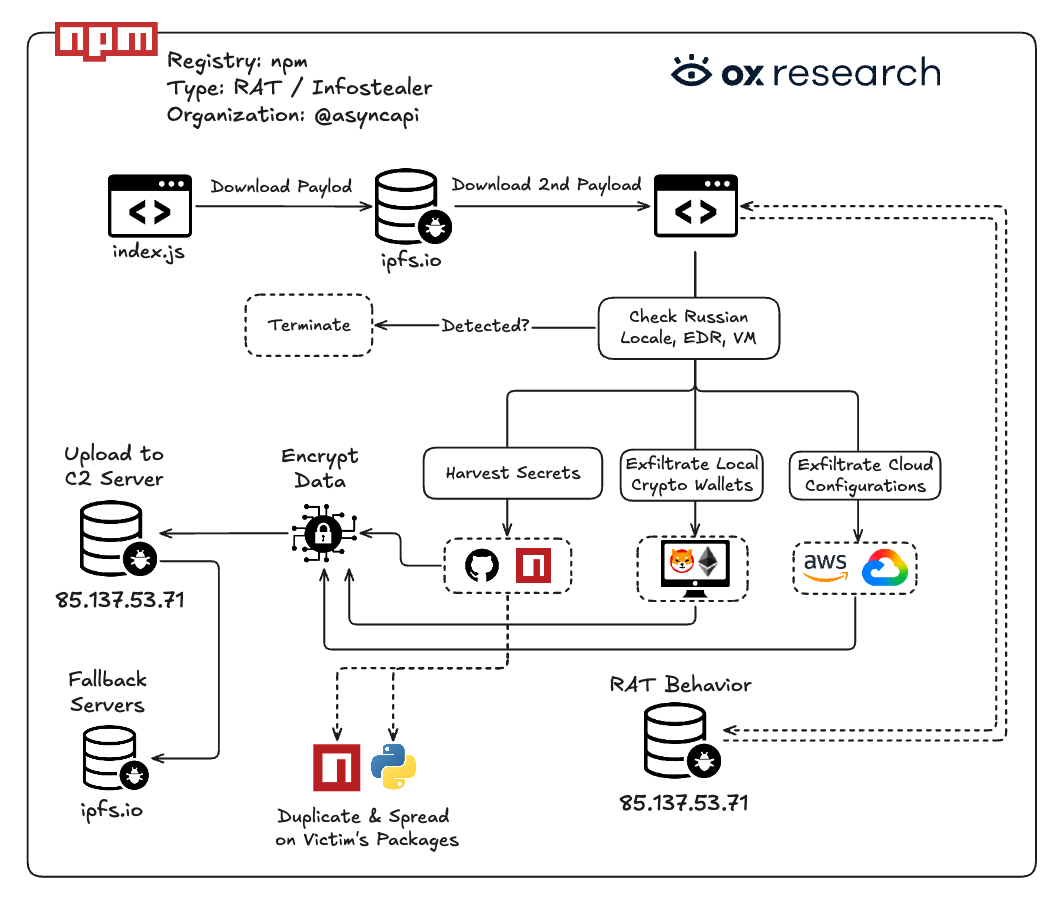
Attackers compromised the AsyncAPI release process and injected malicious code into official @asyncapi npm packages. Because the compromised packages were distributed through the legitimate npm registry and had very high adoption volume, the incident created broad risk across developer endpoints, CI/CD pipelines, and downstream software products.
Public reporting indicates the compromise abused project CI/CD and release credentials, not npm infrastructure itself.
Technical Specifications
| Attribute | Details |
|---|---|
| Incident Type | Software supply chain compromise |
| Impacted Ecosystem | Official @asyncapi npm packages |
| Approximate Exposure Scale | Over 2 million weekly package downloads (reported) |
| Initial Weakness | Insecure GitHub Actions workflow using pull_request_target |
| Credential Exposure | Privileged GitHub PAT obtained and abused |
| Compromise Path | Malicious commits pushed, official release workflow triggered |
| Payload Form | Obfuscated JavaScript executed when affected package loaded |
| Observed Malware Family | Miasma-related RAT activity (reported) |
| C2 Behavior | Malicious code contacted attacker-controlled infrastructure |
| Infrastructure Status | npm platform not compromised; project release process abused |
Affected Products
- Official AsyncAPI npm packages published during the compromised release window
- Developer workstations installing/updating affected package versions
- CI/CD pipelines and build agents resolving compromised dependency versions
- Downstream applications shipping builds with tainted dependencies
Attack Scenario
- Attacker exploits unsafe pull_request_target workflow behavior in project GitHub Actions.
- A privileged token is exposed or captured and used for unauthorized repository/release actions.
- Malicious payload code is inserted into official package source/releases.
- Legitimate release automation publishes compromised package versions to npm.
- Developers and CI systems install or update to affected versions.
- Malicious payload executes on import/load and establishes outbound C2 communication.
- RAT functionality enables remote access, credential theft, and possible lateral movement.
Impact Assessment
- Trusted package integrity is broken, enabling execution of attacker code in build and runtime paths
- Downstream software artifacts may be silently backdoored
- CI/CD trust chain can be subverted across dependent repositories
- Theft risk for source code, secrets, environment variables, and signing materials
- Developer tokens and cloud credentials can be exposed from compromised hosts/pipelines
- Sensitive organization metadata may leak through C2 exfiltration channels
- Incident response and dependency remediation can disrupt build/release operations
- Emergency credential rotations and package pinning can temporarily slow delivery pipelines
- Broad dependency blast radius increases recovery complexity across organizations
Mitigation Strategies
Immediate Actions
- Remove compromised AsyncAPI versions and upgrade to known clean releases
- Rotate GitHub, npm, CI/CD, cloud, and signing credentials where affected packages executed
- Identify and quarantine impacted developer endpoints and build runners
Short-term Measures
- Audit GitHub Actions workflows and eliminate unsafe pull_request_target patterns
- Enforce least privilege token scopes and short-lived credentials for automation
- Require protected branches, mandatory review, and controlled release permissions
Monitoring & Detection
- Monitor CI/CD and endpoint telemetry for suspicious child processes and outbound C2 traffic
- Track dependency changes and alert on unexpected package version drift
- Use SCA and SBOM tooling to locate impacted versions across repositories and artifacts
Long-term Solutions
- Implement package provenance verification and signed release attestation workflows
- Adopt hardened CI/CD runner isolation and secret management guardrails
- Establish continuous supply chain threat modeling and tabletop exercises
Resources and References
Public Reporting
- AsyncAPI npm Supply Chain Attack: Malware Injected Into Packages With 2 Million Weekly Downloads
- AsyncAPI supply chain compromise via GitHub Actions (July 2026)
- Inside the AsyncAPI npm supply chain attack | Cloudsmith
- Coordinated AsyncAPI Supply Chain Attack | StepSecurity
- 2M weekly downloads affected: AsyncAPI npm compromised
- AsyncAPI Supply Chain Compromise via GitHub Actions | Wiz Blog
Last Updated: July 16, 2026