China-Linked Hackers Use TernDoor, PeerTime, BruteEntry in South American Telecom Attacks
UAT-9244 Telecom Espionage TernDoor/PeerTime BruteEntry
Overview
A China-linked threat actor tracked as UAT-9244 was reported targeting telecommunications providers in South America using a custom multi-platform malware toolkit. The campaign deployed TernDoor, PeerTime, and BruteEntry to gain footholds, expand access, and sustain long-term persistence across telecom environments.
Observed tradecraft suggests an intelligence-collection objective focused on durable access to telecom infrastructure and communications-related data.
Technical Specifications
| Attribute | Details |
|---|---|
| Threat Actor | UAT-9244 (China-linked, per reporting) |
| Campaign Type | Cyber-espionage targeting telecom infrastructure |
| Primary Malware | TernDoor (Windows), PeerTime (Linux), BruteEntry (credential brute-force utility) |
| Execution Technique | DLL side-loading via legitimate executable (wsprint.exe) |
| Injected Process | msiexec.exe used for evasion and execution context |
| Persistence Methods | Scheduled tasks and registry Run keys (Windows) |
| Primary Target Sector | Telecommunications providers |
| Operational Goal | Long-term covert access and intelligence gathering |
Affected Products
- Windows systems in telecom enterprise and operations environments
- Linux servers used in telecom infrastructure roles
- Edge devices and network services susceptible to credential brute-force attempts
- Network segments with weak lateral-movement controls
- Status: Active espionage tradecraft with cross-platform persistence patterns
Technical Details
1) TernDoor (Windows Backdoor)
- Delivered through DLL side-loading using trusted executable
wsprint.exe. - Loads malicious DLL
BugSplatRc64.dll. - Injects malicious code into
msiexec.exefor stealth and defense evasion. - Establishes persistence via scheduled tasks and registry Run keys.
- Capabilities include:
- Command execution
- File management
- Process control
- System information collection
- C2 communication
2) PeerTime (Linux Backdoor)
- Deployed on Linux hosts within telecom infrastructure.
- Provides remote command execution and persistent remote access.
- Reported to potentially leverage peer-style communication patterns to obscure operator traffic.
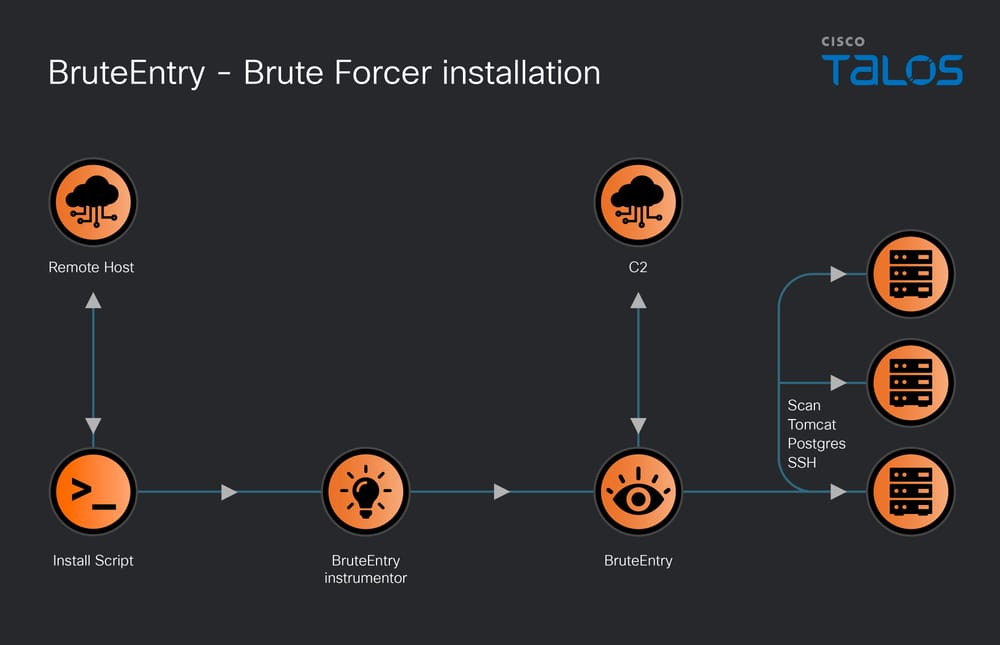
3) BruteEntry Utility
- Used to brute-force credentials on edge devices and exposed services.
- Supports lateral movement and access expansion.
- Enables creation/use of relay-style proxy nodes (Operational Relay Boxes) for campaign resilience.
4) Tooling Ecosystem Notes
- Reported code/behavioral overlap with previously observed China-linked tooling families (e.g., SparrowDoor-like traits).
Attack Scenario
-
Initial Access:
- Attacker gains foothold via exploited vulnerable servers or stolen credentials.
-
Loader/Web Shell Deployment:
- Initial execution artifacts are placed to stage malware delivery.
-
Cross-Platform Implanting:
- TernDoor deployed on Windows assets; PeerTime deployed on Linux systems.
-
Credential Expansion:
- BruteEntry performs credential attacks against edge/network services.
-
Lateral Movement & Relay Setup:
- Adversary moves across telecom segments and establishes operational relay points.
-
Long-Term C2 Operations:
- Persistent C2 channels maintained for surveillance and continued collection.
Impact Assessment
- Long-term surveillance risk across telecommunications environments
- Exposure of communications metadata and operational telemetry
- Potential intelligence collection affecting government/corporate telecom users
- Unauthorized persistent access to core telecom systems
- Potential manipulation of service configurations and management nodes
- Increased risk of adversary-controlled relay infrastructure inside networks
- Operational disruption potential through malware deployment or misconfiguration
- Increased incident response burden from multi-platform compromise
- Elevated risk of follow-on attacks leveraging entrenched footholds
Mitigation Strategies
Patch and Surface Reduction
- Apply current patches across telecom servers, network services, and exposed edge components
- Minimize externally reachable management interfaces and legacy exposed services
Endpoint and Process Monitoring
- Detect DLL side-loading patterns and suspicious DLL loads near trusted binaries
- Monitor anomalous
msiexec.exeexecution chains and process injection indicators - Deploy and tune EDR for multi-platform malware and persistence behavior
Identity and Access Hardening
- Enforce MFA for privileged/admin access paths
- Apply account lockout and rate-limiting controls to counter brute-force attempts
- Rotate exposed credentials and monitor for password-spraying signals
Network Defense
- Segment telecom operational zones and enforce strict lateral movement controls
- Monitor abnormal outbound C2-like traffic and peer-relay communication patterns
- Use threat intel enrichment for UAT-9244 tooling indicators and campaign TTPs
Resources and References
Open-Source Reporting
- China-Linked Hackers Use TernDoor, PeerTime, BruteEntry in South American Telecom Attacks
- China-Nexus Hackers Target Telecommunication Providers with New Malware Attack
- Chinese state hackers target telcos with new malware toolkit
- China telecom cyber espionage campaign
- Chinese hackers target telcos in South America with new malware
Last Updated: March 8, 2026