Iran-linked Cavern Manticore Uses Cavern (Cav3rn) Modular C2 Framework Against Israeli IT Providers and Government Organizations
Iran-Nexus Threat Actor Cavern (Cav3rn) C2 DLL Sideloading Supply Chain Targeting CVE-2025-54068 Context
Overview
An Iran-linked threat cluster dubbed Cavern Manticore is using a modular .NET command-and-control framework called Cavern (Cav3rn) to target Israeli organizations, with a focus on IT service providers and government entities.
The framework reflects a mature, adaptable toolset that supports stealthy DLL sideloading, modular post-exploitation, and multi-protocol C2. Reporting also links activity to a broader Iran-nexus campaign that includes exploitation of CVE-2025-54068 in Laravel Livewire and targeting of internet-exposed services across aviation, energy, and government sectors in the Middle East.
Technical Specifications
| Attribute | Details |
|---|---|
| Threat Cluster | Cavern Manticore (assessed Iran-nexus) |
| Attribution Context | Reported ties to MOIS ecosystem; tactical overlap with MuddyWater and Lyceum/OilRig activity |
| Primary Malware/C2 | Cavern (Cav3rn) modular .NET framework |
| Core Tradecraft | DLL sideloading, modular payloading, post-exploitation orchestration |
| C2 Capability | Multi-protocol command-and-control communications |
| Initial Access Paths | SysAid update-chain abuse, phishing, exposed services, vulnerable web applications |
| Related Vulnerability Context | CVE-2025-54068 (Laravel Livewire RCE) highlighted in parallel MuddyWater operations |
| Target Focus | Israeli IT providers, MSPs, government entities; regional aviation, energy, and public-sector organizations |
| Campaign Objective | Persistent access, credential harvesting, data exfiltration, strategic espionage positioning |
Affected Products
- Organizations using SysAid or similarly exposed IT management/update infrastructure
- Internet-exposed web services vulnerable to known RCE flaws, including Laravel Livewire instances
- IT providers and MSP environments with trusted downstream access
- Government and critical-sector networks connected through provider trust relationships
Attack Scenario
- Attackers gain initial foothold through vulnerable provider infrastructure, software update abuse, phishing, or exposed services.
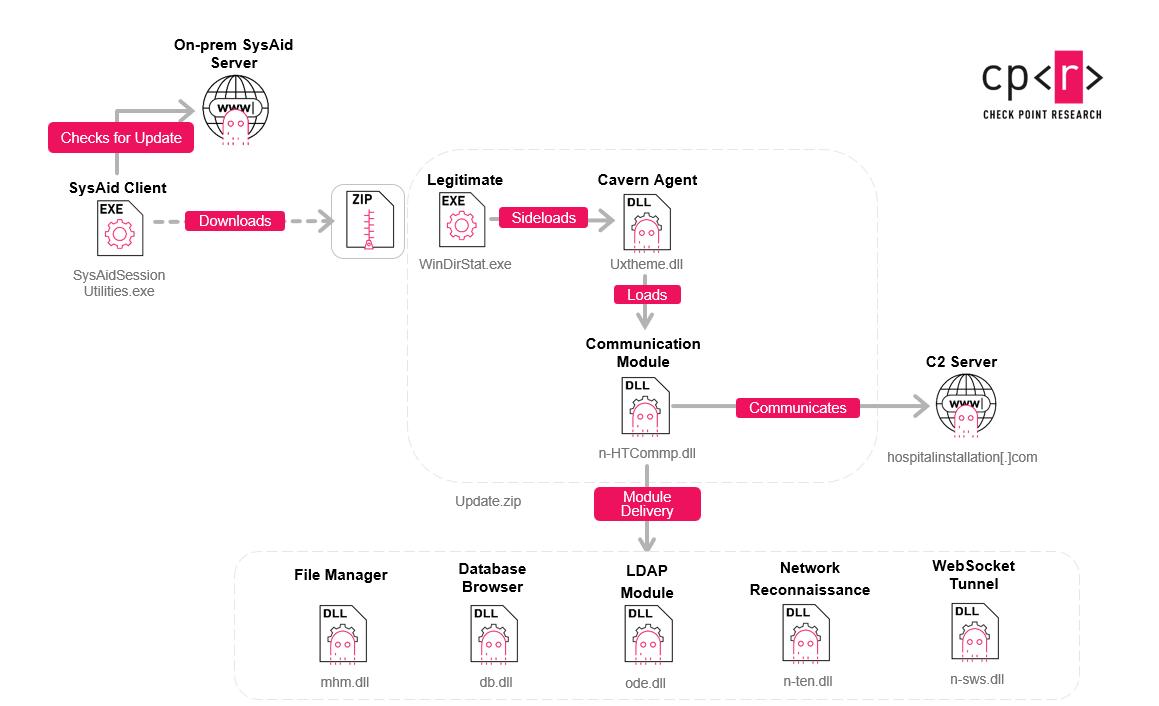
- A trojanized DLL (for example, uxtheme.dll in trusted software directories) is deployed for sideloading.
- The malicious loader launches Cavern Agent components inside trusted application context.
- Agent modules establish multi-protocol C2 and execute post-exploitation tasks including discovery, credential access, and lateral movement.
- Adversaries pivot through compromised IT/MSP trust paths into downstream customer environments.
- In parallel operations, exploitation of CVE-2025-54068 and other service flaws supports credential harvesting and sensitive data exfiltration in aviation, energy, and government sectors.
Impact Assessment
- Trusted management and provider pathways can be abused to alter systems across multiple organizations
- Modular post-exploitation enables long-term tampering with identity and access infrastructure
- Supply-chain style pivots increase blast radius beyond the originally compromised entity
- Confirmed campaign patterns include credential harvesting and exfiltration of sensitive operational data
- Government and critical-sector intelligence exposure can create long-term strategic disadvantage
- Provider compromise can expose data from multiple customers simultaneously
- Persistent intrusions can disrupt IT operations and incident response capacity
- Remediation often requires credential resets, segmentation changes, and service downtime
- Even espionage-focused operations can degrade reliability through containment and recovery actions
Mitigation Strategies
Immediate Actions
- Patch and harden SysAid and similar management/update platforms immediately
- Hunt for DLL sideloading artifacts in trusted application directories and startup paths
- Isolate compromised hosts and revoke/rotate potentially exposed credentials
Short-term Measures
- Prioritize patching of internet-exposed applications, including Laravel Livewire CVE-2025-54068 where applicable
- Harden OWA/VPN authentication with MFA and brute-force protections
- Restrict and continuously validate cross-organization trust paths with IT providers/MSPs
Monitoring & Detection
- Monitor for suspicious DLL loads from non-standard paths and unsigned module execution
- Detect unusual multi-protocol outbound C2 patterns and rare provider-to-customer admin activity
- Alert on anomalous identity behavior, credential abuse, and unexpected lateral movement
Long-term Solutions
- Treat IT providers/MSPs as high-value attack surfaces under zero-trust architecture
- Implement supplier security governance, segmentation, and least-privilege third-party access
- Run recurring threat hunts focused on Iran-linked TTPs and modular C2 persistence patterns
Resources and References
Public Reporting
Last Updated: July 7, 2026