Microsoft Excel Legacy Vulnerability Exploitation (CVE-2009-0238)
CVE-2009-0238 Remote Code Execution Active Exploitation Legacy Software
Overview
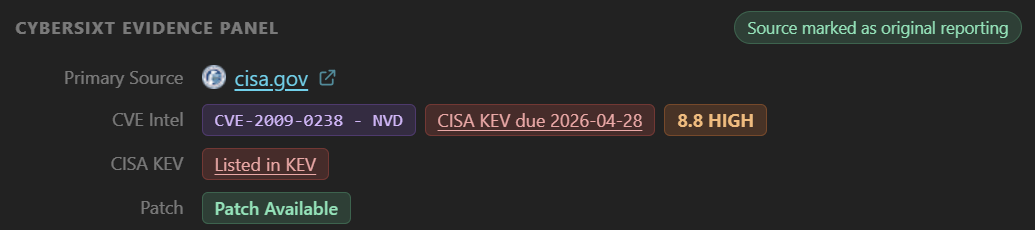
CVE-2009-0238, a memory corruption vulnerability in Microsoft Excel originally disclosed in 2009, has resurfaced in active exploitation campaigns. Despite being over 15 years old, the flaw continues to pose a significant threat because many organizations still operate unpatched or legacy versions of Microsoft Office. The vulnerability has been added to active exploitation catalogs — including CISA's Known Exploited Vulnerabilities (KEV) — underscoring the persistent danger of neglected patch management and the long operational lifespan of well-understood exploits.
Technical Specifications
| Attribute | Details |
|---|---|
| CVE | CVE-2009-0238 |
| Vulnerability Type | Remote Code Execution (memory corruption) |
| CVSS Score | 9.3 (Critical) |
| Affected Software | Microsoft Excel (legacy/unpatched versions); affected Office suites |
| Attack Vector | Malicious .xls Excel file delivered via phishing or downloads |
| Exploitation Method | Crafted file triggers memory corruption on open → arbitrary code execution |
| Root Cause | Improper handling of malformed file structures in legacy Excel parser |
| User Interaction | Opening the malicious file (minimal interaction required) |
| KEV Status | Added to CISA Known Exploited Vulnerabilities catalog |
Affected Products
- Microsoft Excel — legacy and unpatched versions (Office 2003, 2007 era)
- Microsoft Office suites containing unpatched Excel components
- Any system running Excel without current Microsoft security updates applied
Attack Scenario
- Attacker crafts a malicious
.xlsExcel file designed to trigger a memory corruption condition - File is delivered to the victim via a phishing email, file-sharing link, or malicious download
- Victim opens the attachment using a vulnerable, unpatched version of Microsoft Excel
- Excel's legacy file parser processes the malformed file structure
- Memory corruption is triggered automatically — no significant additional user interaction required
- Arbitrary code executes on the victim's system under the privileges of the logged-in user
- Attacker establishes an initial foothold and may install a backdoor or remote access tool
- Sensitive data on the compromised system is accessed and exfiltrated
- Attacker moves laterally through the network using the compromised endpoint as a pivot
- Persistence mechanisms are deployed to maintain long-term access
Impact
- Arbitrary remote code execution under victim-level privileges
- Full compromise of the targeted workstation or server
- Credential harvesting and sensitive data exfiltration
- Lateral movement enabling broader network compromise
- Persistent backdoor installation for continued attacker access
- Amplified risk on systems with excessive user privileges
- Unauthorized access to confidential files, financial records, and internal data
- Potential ransomware or malware deployment across connected systems
- Business disruption from incident response and system remediation
- Regulatory exposure if personal or financial data is exfiltrated
- Reputational damage from breach resulting from a 15-year-old, known vulnerability
- Demonstrates the long tail of exploitable legacy vulnerabilities — functional 15+ years after disclosure
- Reinforces attacker preference for reliable, well-documented exploits over novel zero-days
- Organizations running unsupported Office versions represent a structurally persistent attack surface
- CISA KEV addition signals active, ongoing exploitation — not merely theoretical risk
- Highlights systemic patch management failures in both enterprise and SMB environments
Mitigations
Immediate Actions
- Apply all current Microsoft Office and Excel security updates — ensure systems are not running unpatched legacy versions
- Block or quarantine incoming email attachments with
.xlsand other legacy Office formats where not required - Enable endpoint protection and EDR solutions to detect exploit behavior and post-exploitation activity
- Disable automatic execution of macros, external content, and legacy Office features in Group Policy or Trust Center settings
Long-Term Measures
- Replace unsupported or end-of-life Office versions with currently supported releases
- Implement a structured, timely patch management process with defined SLAs for critical updates
- Conduct user awareness training to reduce the likelihood of phishing attachments being opened
- Use sandboxing or isolated environments for opening untrusted files from external sources
- Apply the principle of least privilege to limit the impact of any successful exploitation to a single user context
Resources
Open-Source Reporting
Last Updated: April 16, 2026