Cisco Catalyst SD-WAN Zero-Day Vulnerability - CVE-2026-20182
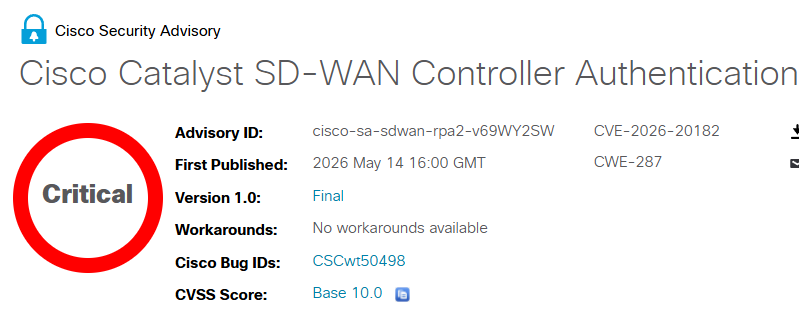
CVE-2026-20182 Cisco SD-WAN Zero-Day Authentication Bypass
Overview
Cisco disclosed and patched CVE-2026-20182, a critical zero-day vulnerability affecting Catalyst SD-WAN products. The flaw was actively exploited in the wild and allowed attackers to bypass authentication controls and gain privileged administrative access to SD-WAN infrastructure.
This is the sixth Cisco SD-WAN zero-day reported as exploited during 2026.
Technical Specifications
| Attribute | Details |
|---|---|
| CVE | CVE-2026-20182 |
| Affected Components | Cisco Catalyst SD-WAN Controller (vSmart), Cisco Catalyst SD-WAN Manager (vManage) |
| Vulnerable Service | vdaemon |
| Protocol / Port | DTLS over UDP 12346 |
| Vulnerability Type | Authentication bypass via trusted-peer impersonation |
| Attack Vector | Specially crafted DTLS packets in SD-WAN peering authentication workflow |
| Privileges Required | None on target device prior to exploitation |
| Observed Status | Actively exploited in the wild (zero-day) |
Affected Products
- Cisco Catalyst SD-WAN Controller (vSmart)
- Cisco Catalyst SD-WAN Manager (vManage)
- Internet-exposed SD-WAN management interfaces and peering paths
Attack Scenario
-
Discovery: The attacker scans for exposed Cisco SD-WAN management or peering endpoints.
-
Impersonation via DTLS: The attacker sends crafted DTLS packets to the
vdaemonservice on UDP port12346and impersonates a trusted SD-WAN peer. -
Authentication Bypass: Peer authentication is bypassed, granting unauthorized privileged administrative access.
-
Post-Exploitation Actions: The attacker adds malicious SSH keys, modifies NETCONF configurations, escalates privileges (up to root), and establishes persistence.
-
Operational Abuse: With control over SD-WAN infrastructure, the attacker can manipulate traffic routing and policy enforcement across connected branches.
Impact Assessment
- Full administrative control of SD-WAN control-plane components
- Traffic interception, rerouting, policy tampering, and WAN disruption
- Potential malware deployment across branch-connected environments
- Exposure of sensitive enterprise traffic and configuration data
- Persistence for long-term espionage and follow-on attack operations
- Increased risk of lateral movement into downstream enterprise assets
- Outages and degraded connectivity for distributed branches
- Incident response and recovery complexity at infrastructure scale
- Elevated regulatory and contractual impact when sensitive data is affected
Mitigation Strategies
Immediate Remediation
- Immediately apply Cisco security patches and fixed releases.
Exposure Reduction
- Restrict SD-WAN management interfaces from internet exposure.
- Allow access only from trusted IP addresses.
Detection and Hardening
- Audit SSH keys and SD-WAN peer relationships for unauthorized entries.
- Review logs such as
/var/log/auth.logfor suspicious authentication activity. - Monitor for unauthorized NETCONF changes and unexpected peer connections.
- Implement network segmentation and continuous monitoring of SD-WAN control-plane systems.
Resources and References
Open-Source Reporting
- Cisco Catalyst SD-WAN Controller Authentication Bypass Vulnerability
- CVE-2026-20182 - Vulnerability Details - OpenCVE
- Cisco patches another actively exploited SD-WAN zero-day (CVE-2026-20182) - Help Net Security
- Cisco warns of new critical SD-WAN flaw exploited in zero-day attacks
- Maximum Severity Cisco SD-WAN Bug Exploited in the Wild
- Cisco Patches Another SD-WAN Zero-Day, the Sixth Exploited in 2026 - SecurityWeek
Last Updated: May 17, 2026