LANDFALL Android Spyware — Samsung Galaxy Zero-Day Campaign
CVE-2025-21042 Android Spyware / Zero-day Exploit Remote Code Execution
Overview
A previously unknown Android spyware family dubbed LANDFALL was used in targeted attacks against Samsung Galaxy devices in Iraq, Iran, Turkey, and Morocco. The campaign exploited a zero‑day vulnerability CVE‑2025‑21042 (CVSS 8.8) — an out‑of‑bounds write in Samsung's proprietary image codec library (libimagecodec.quram.so) — enabling remote code execution via crafted DNG (Digital Negative) image files.
Technical Specifications
| Attribute | Details |
|---|---|
| CVE ID | CVE-2025-21042 |
| Vulnerability Type | Out‑of‑bounds write → Remote Code Execution |
| Exploited Component | libimagecodec.quram.so (Samsung image decoder) |
| Attack Vector | Malicious DNG image (delivered via messaging apps such as WhatsApp) |
| Complexity | Low to Medium (crafted image + embedded payload) |
| Privileges Required | None (triggered by preview/display) |
| User Interaction | Likely none (preview/processing) |
| CVSS Score | 8.8 (High) |
| Affected Devices / OS | Galaxy S22, S23, S24, Z Fold 4, Z Flip 4 on Android 13–15 (before April 2025 patches) |
Technical Details
-
Exploit chain:
-
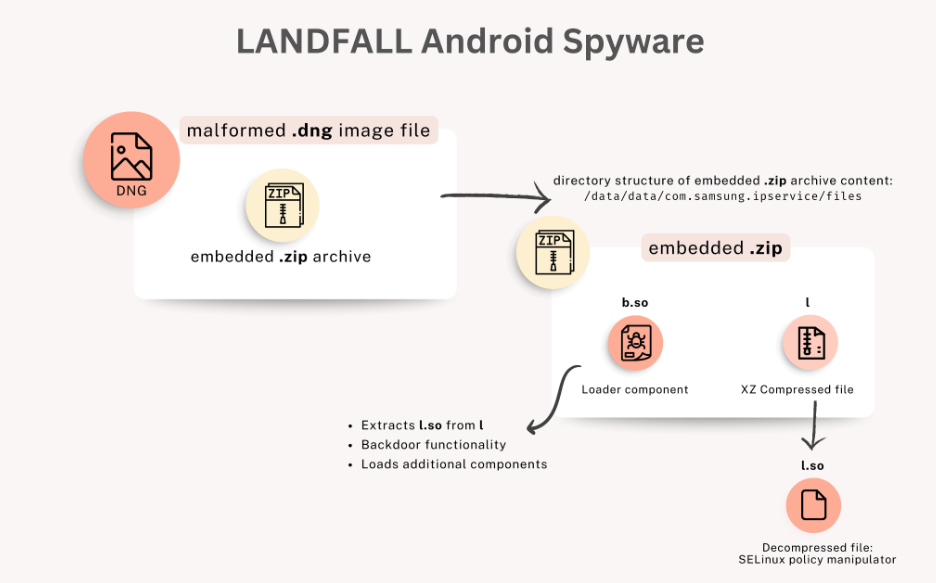
Malicious DNG triggers an out‑of‑bounds write in
libimagecodec.quram.so. - The crafted DNG contains an embedded ZIP that extracts a shared object (SO) to disk.
- A secondary SO manipulates SELinux policy to escalate privileges and achieve persistence.
- Payload & Capabilities: LANDFALL provides modular surveillance capabilities: microphone/audio capture, geolocation, camera/photos, contacts, call logs, SMS, file exfiltration, and arbitrary command execution. It implements encrypted C2 communications and dynamic module loading.
- Persistence & Evasion: The spyware modifies SELinux, disables debugging and logging, uses certificate pinning and encrypted C2, and resists removal across reboots.
- Attribution: No definitive attribution; however, some C2 infrastructure overlaps with known APT clusters (e.g., Stealth Falcon / FruityArmor).
Attack Scenario
- Recon & Targeting: Adversary selects high‑value targets and prepares a crafted DNG lure.
- Delivery: Malicious DNG is sent via WhatsApp (or other messaging channels). The wafer may be disguised with filenames resembling legitimate images.
- Trigger: The victim's device processes the DNG (gallery preview or messaging app thumbnail generation), triggering the vulnerable decoder and achieving RCE.
- Payload Drop: Embedded ZIP extracts and loads malicious SO libraries; SELinux is manipulated for privilege escalation.
- C2 Communication: LANDFALL beacons to attacker C2 over encrypted channels and pulls additional modules.
- Surveillance & Exfiltration: Data is collected and exfiltrated to attacker infrastructure.
- Persistence: Malware ensures survival across reboots and attempts to hide from user and security tools.
Impact
- Full device takeover: Persistent root control and comprehensive data exfiltration.
- Espionage: Audio, location, messages, and sensitive files exposed; severe privacy and national security implications for targeted users.
- Widespread risk: Affected models were widely deployed prior to the April 2025 patch, potentially exposing large user populations in the region.
- APT‑grade operations: The complexity and infrastructure point to a sophisticated adversary.
Mitigations
- Patch: Install Samsung’s April 2025 security update or later immediately.
- Avoid opening suspicious media: Do not preview or open unsolicited images, especially DNG files.
- Restrict DNG handling: Block or disable automatic processing of DNGs from untrusted sources in messaging apps where possible.
- Mobile forensics: Examine WhatsApp/media directories for suspicious DNGs and embedded SO files if compromise is suspected.
- Enterprise guidance: Advise high‑risk personnel (NGOs, journalists, government staff) to apply patches, limit app permissions, and use hardened devices.
- Monitoring & detection: Watch for unusual SELinux policy changes, unexpected SO files, and anomalous network beaconing from devices.
Indicators & IOC
- Malicious filenames observed:
WhatsApp Image 2025-02-10 at 4.54.17 PM.jpeg,IMG-20240723-WA0000.jpg(actually DNG with embedded ZIP) - C2 infrastructure and domains reported in vendor writeups (consult references below for exact IOCs).
Resources and References
Official Documentation
- LANDFALL Android spyware targeted Samsung phones via zero‑day - SecurityWeek
- LANDFALL abused zero‑day to hack Samsung Galaxy phones – TechCrunch
- Samsung zero‑click flaw exploited to hack devices – The Hacker News
- LANDFALL spyware exploited Samsung zero‑day in Middle East attacks – SecurityAffairs
- Landfall is new commercial‑grade Android spyware – Unit42
Risk Level: Critical
LANDFALL enables persistent, stealthy surveillance and full device compromise. Prioritise patching and forensic investigation for suspected victims.